Where does the AI productivity surplus go?"
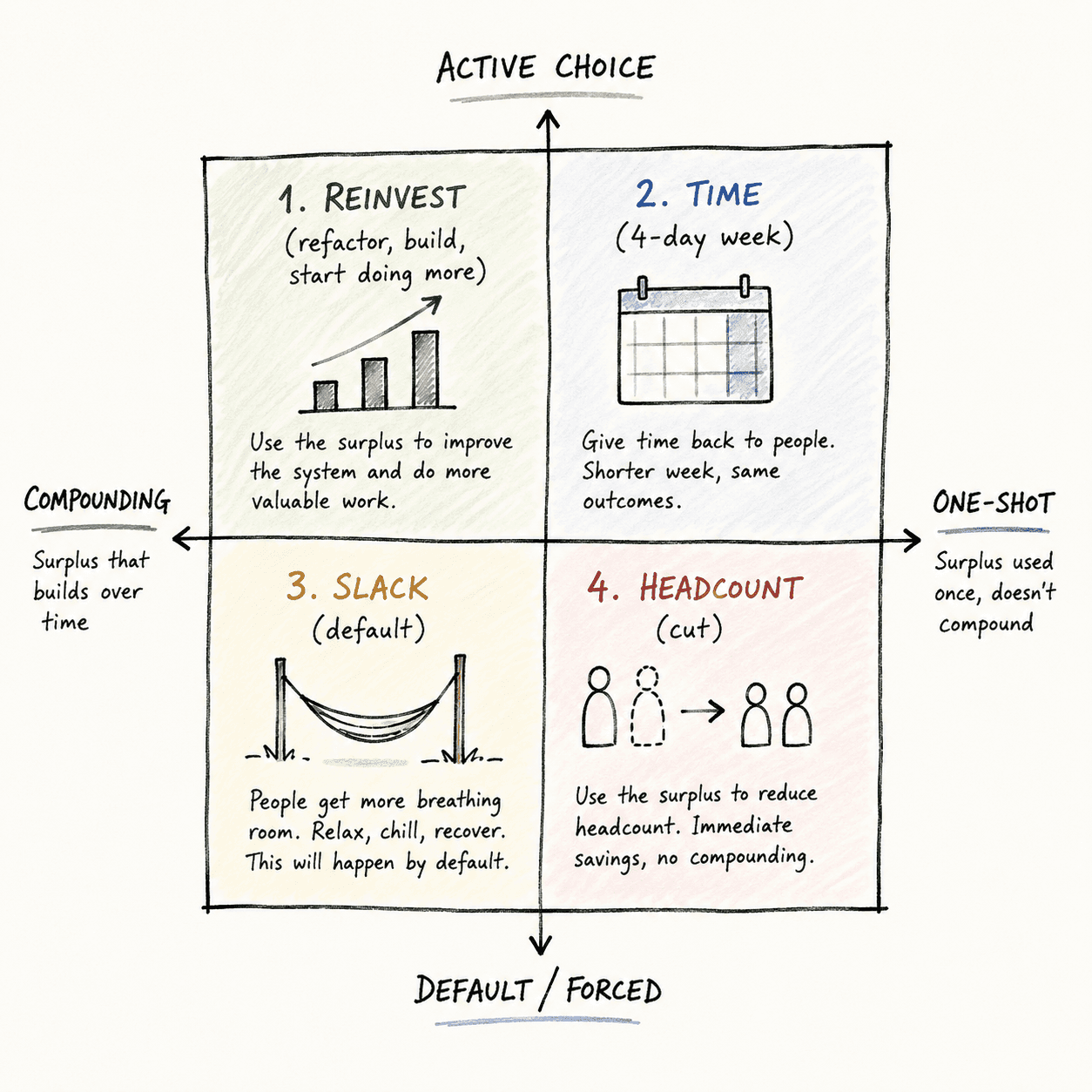
Where does the AI productivity surplus go?
Every engineering leader I speak to admits the same thing: AI tooling delivers a productivity boost of at least 40%. Some say more. Nobody disputes the number anymore.
So here's the question almost nobody is answering cleanly: where did that 40% go?
Not in theory. In your P&L. In your delivery dates. In your team sizes. In the price your customers pay. Look at any of those numbers from 18 months ago and today, and most of you will see roughly the same picture. The surplus is real at the individual level — and almost entirely invisible at the organisational level.
There are really only four places it can go, and you're going to choose one whether you decide to or not:
1. It dissipates into slack. Teams get more relaxed, work expands to fill the time, nothing structurally changes. The surplus is real but unmeasurable. This is the default — and where most enterprises are right now.
2. It gets cashed in as headcount reduction. Legible to finance, brutal to culture, and a one-time gain. You've converted a compounding capability into a single cost cut.
3. It gets reinvested into the work that was always too expensive. Refactors, platform work, quality, the long-deferred backlog. This is the option that compounds — you end up with a structurally better company in 18 months.
4. It gets institutionalised as time. Shorter weeks, working from home, retention advantage, a different deal with the workforce. Coherent, defensible, but commits you to a specific strategic posture.
Option 1 is what's happening by default.
Option 2 is what happens when boards lose patience.
Options 3 and Option 4 are the ones that require active choice — and the window to make that choice cleanly is closing.
Here's how I got there.
The surplus is real
At the individual contributor level, the evidence is everywhere. Writing a document, a deck, a shell script, a new service, a blog post — all of it is dramatically faster. Engineers feel it. PMs feel it. Designers feel it. The friction of producing artifacts has collapsed.
This isn't controversial. Walk into any team using modern AI tooling and ask them privately whether they're faster. They'll tell you yes, and they'll tell you by how much.
But organisations can't see it
Now look at the same companies from the outside. Quotes haven't dropped. Team sizes haven't shrunk. Delivery dates haven't moved meaningfully. The same number of people are working on the same kinds of projects with the same kinds of timelines.
The surplus exists. It just isn't being captured anywhere a CFO can point to.
So where did it go? It went to the engineers. Quietly, and mostly without anyone naming it out loud. Engineers have a few free hours a day that didn't used to exist. Some use it to start side projects. Some spend more time with family. Some go deeper on craft. Some just exhale for the first time in years.
I want to be careful about how I describe this, because the framing matters. This isn't theft. Engineering wages have been stagnant in real terms for the better part of a decade. Pay rises haven't kept up with inflation or tax drag. A bit of breathing room is overdue compensation, not opportunism. The people doing the work captured the surplus first because they were the closest to it, and frankly because they were owed it.
But "owed it" doesn't make the situation stable. And that's the part CTOs need to think about now, not in twelve months.
Why this is unstable
Cloud costs keep rising. AI tooling is itself a growing line item. Boards are starting to ask the obvious question: we authorised significant spend on AI productivity tools — where is the productivity? The patience runway for "trust us, it's working" is shorter than most engineering leaders think.
When the runway ends, the conversation gets forced. And when it gets forced, the easiest answer wins by default.
Why headcount is the easiest answer — and the worst one
The most obvious way to materialise an AI productivity gain is to reduce the team. If three engineers can now do the work of five, you can either keep five and pocket the surplus as slack, or run with three and pocket it as margin. Margin is legible. Slack is not. CFOs understand margin.
This is why the layoffs framed as "AI efficiency" will keep coming. Not because AI made the people redundant in any literal sense, but because headcount is the only lever that translates the surplus into a spreadsheet number without requiring anyone to rethink anything.
It's the easiest answer. It's also a one-shot. You're converting a once-in-a-generation capability expansion into a single cost cut. Once you've cut, you've cashed in the option. There's nothing left to compound.
The alternative: stop rationing
For the last decade, software organisations have been rationing. Every refactor deferred. Every architectural cleanup lost to next quarter's roadmap. Engineers learned not to ask. Technical debt accumulated because paying it down was a luxury nobody could justify.
That rationing existed because engineering capacity was the binding constraint. It isn't anymore.
The surplus you're trying to materialise is the same surplus that makes all the deferred work cheap. The three-year refactor — now a one-month project. The observability rebuild, the legacy migration, the test coverage you knew you needed, the documentation that explains why — suddenly affordable. Previously the answer was "good luck with that." Now it can be "fine, next month."
The companies that win this period won't use AI to do the same work with fewer people. They'll use it to do the work that was always too expensive to justify.
And the 4-day week is real too
It's worth naming honestly: institutionalising a portion of the surplus as time is now a genuine strategic option. Several companies are running 4-day weeks. It's not science fiction.
The question isn't whether it's possible. The question is whether you'd rather compete on talent retention by giving back time, or compete on output by reinvesting the surplus into ambition. Both are coherent. Both beat the default.
The surplus is real. The four options are real. The choice is yours to make or to have made for you.
We're working through this with clients now, because the honest answer is that most of them don't have a framework for the question yet. They have AI tooling. They don't have an AI economics.


Andrey Kozichev



Related Posts

governance
Oct 30, 2025
Ever inherited a data platform where nobody knows how schemas evolved, configurations vanish after migrations, and 500+ models have no lineage? While software development embraced DevOps years ago, data engineering got left behind - stuck with clickops, tribal knowledge, and the dangerous myth that "we'll automate later." We rebuilt our data platforms with a code-first approach using Terraform, dbt, and GitOps, achieving an 80% reduction in manual work and transforming unreliable deployments into boring, repeatable operations. Here's why if it's not in code, it doesn't exist - and why that principle saved our infrastructure.

governance
Jan 29, 2024
Deleting data is tough and feels like a big responsibility. The best way to avoid hoarding is to not gather unnecessary data in the first place.